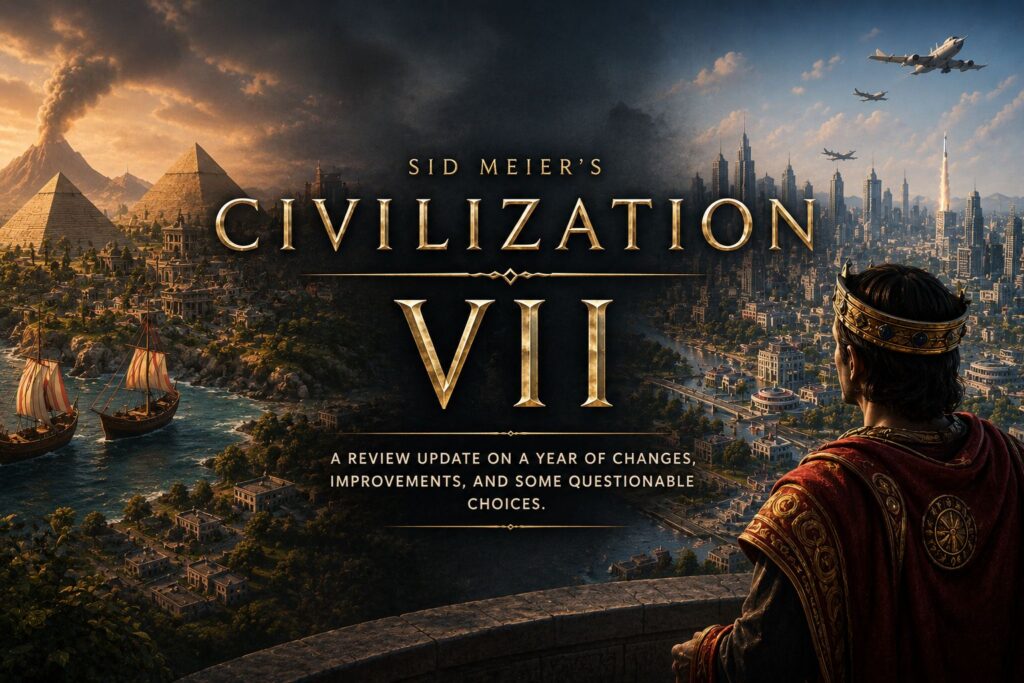
When I reviewed Sid Meier’s Civilization VII back in February 2025, I gave it a 9 out of 10. That score raised a few eyebrows because the conversation surrounding the game was already turning sour. Players criticized the interface, questioned the new Age system, and weren’t convinced that switching civilizations every era belonged in a Civilization game. While I agreed that Firaxis had launched a strategy game that desperately needed another layer of polish, I also believed there was something genuinely exciting underneath those rough edges. Civilization VII wasn’t trying to be Civilization VI with prettier graphics or a handful of new leaders. It was willing to rethink ideas that the series had carried for decades, and even when those ideas didn’t always land, I appreciated that Firaxis was willing to take the risk.
A year later, after spending considerable time with the Test of Time update and version 1.4.1, I still believe that original score was justified. Civilization VII is unquestionably a better game than it was at launch. The interface has matured, quality-of-life improvements have transformed everyday play, and many of my original frustrations have been addressed. What I didn’t expect, however, was that some of those improvements would come at the expense of the very ideas that made Civilization VII feel different in the first place.
Civilization VII wasn’t afraid to question ideas that had defined the franchise for decades. The Age system fundamentally changed how campaigns unfolded. Civilization switching challenged the long-standing notion that your identity had to remain fixed from turn one until the victory screen. It wasn’t perfect, but it was different, and for a series entering its seventh numbered entry, different was exactly what I wanted.
Fast forward more than a year later, and Civilization VII has changed considerably. The Test of Time update, alongside version 1.4.1, represents the biggest overhaul the game has received since launch. The user interface has improved dramatically, quality-of-life features finally feel worthy of the Civilization name, and many of the rough edges that dominated early conversations have been smoothed over. Civilization VII is undoubtedly a better game today. Just that I’m just not entirely convinced it’s a better Civilization VII.
The improvements are immediately noticeable. Back when I first reviewed Civilization VII, one of my biggest frustrations wasn’t even the gameplay itself. It was the amount of effort required just to understand what was happening. Important calculations were hidden. Tooltips lacked meaningful detail. Looking up mechanics often meant opening external guides because the game simply wasn’t interested in explaining itself. That criticism doesn’t really hold up anymore.
One area where Civilization VII has unquestionably improved is the Civilopedia, but it’s also one of the clearest reminders that Firaxis still has work to do. At launch, it often felt like an encyclopedia that was more interested in explaining the historical inspiration behind a mechanic than actually teaching you how that mechanic worked. That balance has shifted somewhat over the last year. Tooltips now surface more useful information, navigation is cleaner, and it’s far easier to trace where certain calculations come from without immediately opening a browser tab.
The problem is that the Civilopedia still struggles with the question of what it actually wants to be. Is it a gameplay manual, or is it a historical companion? Right now, it tries to be both, and neither side feels fully realized. There are still moments where you’re looking up a mechanic only to be met with pages of historical context before the game ever tells you what the mechanic actually does. Other entries mention related systems without explaining how they interact, forcing you to jump between multiple articles just to answer what should have been a straightforward question.
Navigation remains another sticking point. Even after the improvements, finding specific information often feels like an exercise in deduction rather than discovery. If you know exactly what category Firaxis filed something under, you’ll eventually get there. If you don’t, you’re left bouncing between tabs hoping you’ve guessed correctly. Some mechanics are explained in places you wouldn’t naturally think to look, while other entries reference concepts without linking to them directly. For a strategy game built on interconnected systems, that’s an unnecessary hurdle.
What frustrates me most is that Civilization VII already has the information. It’s just not particularly good at presenting it. A stronger search function, better cross-referencing between related mechanics, and clearer gameplay-first explanations would solve most of these issues without sacrificing the historical flavor that the Civilopedia has always offered. Compared to where it was at launch, it’s unquestionably an improvement, but compared to what a modern strategy game with this many interconnected systems actually needs, it still feels like it’s one update away from becoming genuinely excellent.
Did Firaxis Listen Too Well?
This is where Civilization VII becomes much more difficult to talk about. The improvements to the interface, the Civilopedia, and overall usability are easy to praise because they’re solving obvious problems. Nobody enjoyed digging through menus just to figure out why their empire suddenly lost Happiness or where a specific modifier was coming from. Those changes don’t fundamentally alter Civilization VII. They simply allow the game to communicate its ideas more effectively. The more controversial updates aren’t technical, rather they’re philosophical.
Not long after Civilization VII’s launch, Take-Two CEO Strauss Zelnick described the game as “a bridge too far” for many longtime Civilization fans. Looking at how Firaxis has approached updates over the past year, it feels difficult not to see that sentiment reflected in the game’s evolution. The studio has clearly spent the last several patches trying to rebuild trust with players who wanted something closer to previous Civilization games.
I understand why. When a franchise has existed for more than thirty years, every new idea is naturally going to be measured against decades of expectations. Civilization VII didn’t just introduce new mechanics. It questioned assumptions that many players had never really thought about before, particularly the idea that your civilization should remain unchanged from the Ancient Age all the way to the Information Age.
That conversation quickly became dominated by one feature: civilization switching. Ironically, I still don’t think civilization switching was ever Civilization VII’s biggest problem. It was certainly the most visible one, and probably the easiest target for criticism, but it wasn’t the mechanic that made the game difficult to enjoy at launch. Most of those frustrations came from presentation, communication, and onboarding. Civilization VII often struggled to explain why certain civilizations became available, what changing civilizations actually accomplished, or how players could plan around the system instead of reacting to it. Those were teachable problems.
Instead of doubling down on teaching those mechanics, Firaxis gradually shifted toward giving players ways to avoid them altogether. That’s where Timeless Civilizations enter the picture.
A Safer Civilization
Timeless Civilizations allow players to remain with the same civilization throughout all three Ages, much like previous entries in the series. It’s an option many players asked for, and from a purely accessibility standpoint, I think it’s a good addition. More player choice is rarely a bad thing, especially in a strategy game where customization has always been part of the appeal.
What gives me pause isn’t the feature itself, it’s what the feature represents. Civilization VII launched with a very clear identity. Whether players agreed with it or not, Firaxis was trying to encourage a different way of thinking about historical progression. Empires evolved. Civilizations transformed. Every Age became an opportunity to rethink your strengths rather than simply extending the same strategy for another hundred turns.
Timeless Civilizations don’t erase that vision. Civilization switching still exists, and players who enjoy it can continue using it exactly as before. But the broader direction of the updates increasingly feels like Firaxis stepping away from its own confidence. Almost every major change since launch has made Civilization VII feel a little more familiar. That familiarity undoubtedly makes it easier to approach, I’m just not convinced it makes the game more interesting.
One of the smartest additions in the Test of Time update is Syncretism, and I wish more of the redesigns had followed that philosophy instead. Being able to borrow unique units or improvements from civilizations currently in their apex Age preserves the idea that cultures influence one another without forcing dramatic shifts onto the player. It expands the original concept instead of replacing it. That’s the kind of refinement I hoped Civilization VII would spend its first year pursuing.
Victory Without Evolution
The biggest example of Firaxis choosing simplification over refinement can be found in the victory conditions. I’ll be the first to admit that Civilization VII’s original Age objectives weren’t perfect. Some were awkwardly balanced, others became confusing as campaigns progressed, and there were certainly moments where it wasn’t entirely clear what the game expected from you.
The answer, however, wasn’t to flatten them. Today, military victories revolve around Domination points. Economic victories chase GDP. Scientific victories become Innovation. Cultural victories revolve around Tourism. They’re all clean, easy to understand, and significantly easier to communicate than the launch versions, plus they’re also remarkably similar.
Rather than asking players to engage with unique mechanics that reflected each Age, every path now feels like a race to push a different number high enough before the countdown timer expires. It’s elegant design from a usability perspective, but it lacks the personality that made Civilization VII’s structure feel distinct.
One of my favorite aspects of the launch version was how each Age gave me permission to change my mind. A civilization that dominated militarily during Antiquity didn’t necessarily have to continue down that path forever. Exploration might encourage economic expansion. The Modern Age could become a cultural victory instead. Those pivots felt natural because the game encouraged them. But today, the optimal strategy often feels like committing to a victory condition early and simply refining it over the next two Ages. Cleaner but it’s also far less adventurous.
So… Is Civilization VII Worth Playing in 2026?
The easiest answer is yes. If you were one of the many players who walked away from Civilization VII during its launch window because the interface felt unfinished, the game failed to explain itself, or the overall experience simply felt rough around the edges, there’s never been a better time to return. The Test of Time update alone makes the game substantially easier to understand, and the dozens of quality-of-life improvements added over the past year remove much of the unnecessary friction that dominated early discussions.
I don’t regret giving Civilization VII a 9 back in 2025, and if anything, the last year has reinforced why I scored it as highly as I did. Back then, I saw a strategy game with an incredible foundation hidden beneath a frustrating presentation. Today, that foundation is much easier to appreciate because Firaxis has finally done the work of making its systems communicate with the player instead of against them.
What I didn’t anticipate was how much of Civilization VII’s evolution would be spent looking backward, and maybe that’s inevitable. Every long-running series eventually reaches a point where innovation becomes difficult because every change is measured against nostalgia. Civilization has been around for more than thirty years, and millions of players have developed their own idea of what a Civilization game should look like. Any attempt to challenge those assumptions is always going to be met with resistance. But I also think that’s why Civilization VII fascinated me at launch because it wasn’t trying to become Civilization VI.5.
It wasn’t simply adding another layer of districts, another handful of leaders, or another collection of civilizations before calling it a sequel. It was willing to ask uncomfortable questions about how Civilization campaigns should flow, whether civilizations should remain static, and if players should be encouraged to reinvent their strategy several times throughout a single playthrough.
Not all of those ideas worked. Some absolutely needed refinement, others simply needed better explanations. The problem is that refinement and retreat aren’t the same thing. Over the past year, Firaxis has done an excellent job addressing Civilization VII’s usability problems. The interface is dramatically better, the game respects the player’s time far more than it did at launch, and many of the improvements genuinely make every campaign more enjoyable.
Where I remain conflicted is the growing sense that Civilization VII is becoming more comfortable being compared to Civilization VI than it is being judged on its own ideas. That’s most obvious in the victory conditions. It’s visible in Timeless Civilizations. It’s reflected in a design philosophy that increasingly favors familiarity over experimentation. None of those changes make Civilization VII a worse game. In fact, many players will probably enjoy it more because of them.
The irony is that Firaxis has already shown it knows how to evolve these ideas without abandoning them. Syncretism is a perfect example. Instead of discarding civilization switching, it expands on it by letting cultures influence one another in meaningful ways. It feels like a natural continuation of Civilization VII’s identity rather than an apology for having one.
I wish more of the updates had followed that approach. That doesn’t mean Civilization VII has reached its ceiling, in fact, far from it. If Civilization V and Civilization VI taught us anything, it’s that Firaxis tends to build its best Civilization games over several years rather than several months. Expansions don’t just add civilizations and leaders. They redefine systems, reshape mechanics, and often become the versions players remember years later.
Civilization VII feels like it’s standing at that crossroads right now. The framework is finally solid enough that Firaxis can stop fixing the launch and start building the future.
My hope is that future expansions continue polishing what Civilization VII introduced instead of sanding away every sharp edge that made it different because that’s ultimately why I still believe in this game and not because it’s finally easier to play, but because I still think there’s a version of Civilization VII that only Civilization VII can become. And I’d hate to see Firaxis spend the next few years chasing Civilization VI when it already has the foundation for something entirely its own.