Developer: Gamkat
Publisher: No More Robots
Reviewed On: PC
Available On: PC, Nintendo Switch
Release Date: March 12, 2026 (PC), TBA (Nintendo Switch)
The cozy game genre always seems to surprise me. While some players choose to play Escape from Tarkov as a means of relaxing after a long day’s work, (Respect!) others choose to spend their time tending crops or managing a growing business. Piece by Piece does the latter to a lesser extent, instead favoring the repair of small possessions. So, is there enough here to please the cozy crowd? Or do we have to pivot to a more profitable business model? That’s what we’re about to find out in this Piece by Piece review.
Piece by Piece is a cozy shop simulator with a lot of heart. Players take control of Oku, the always helpful repairman who doesn’t think twice about repairing the cherished possessions of his forest neighbors. As the town’s sole repairman, you are responsible for fixing, painting, and restoring treasured items the community holds dear. Be it a shattered cooking pot or a worn-out toy racing car. In due time, you’ll even earn enough to be able to buy and sell pre-owned items so that each item can find a new home.
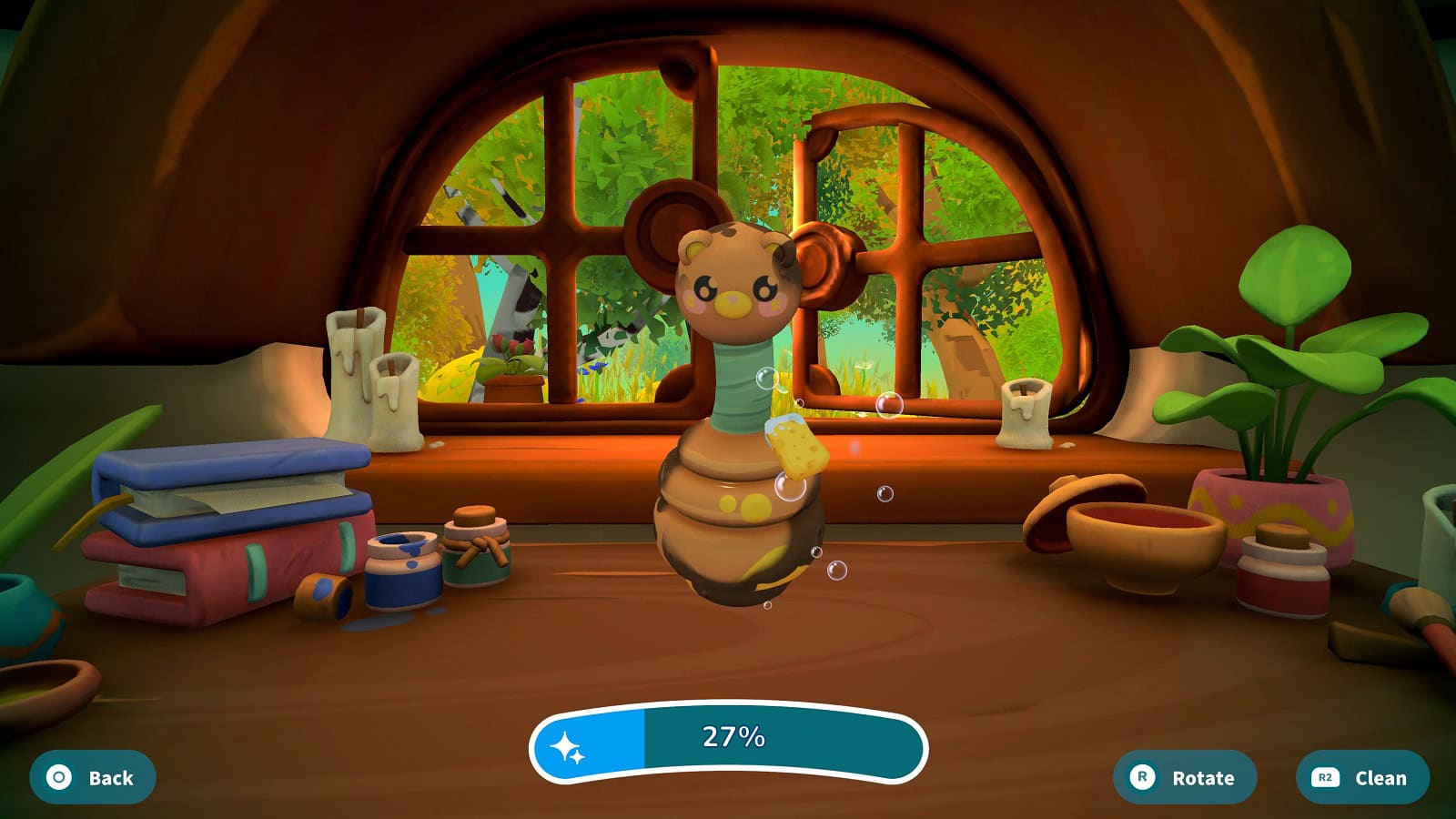
The game begins with Oku on a train returning home to his childhood town. Oku has just inherited his grandfather’s repair shop after many years of service to the community. In fact, Oku’s grandfather is so well-known to the community that people sometimes mistake Oku for a younger version of his grandfather. After cleaning the stop and making it as customer-friendly as possible, Oku opens the doors, ready to receive the day’s work orders.
Piece by Piece is not the most comprehensive repair sim out there. The only tool you have on hand to work with appears to be a pot of glue. But what you do is where it earns its cozy status. The way repairs work is that you are given several pieces to choose from. Each piece corresponds to a location indicated by an outline. You turn both the outline and the piece until they align within a threshold. Once aligned, you can set the piece and move to the next one until the object is fully rebuilt. The game has more in common with puzzle solvers, but one look at the art style and you know what you were getting yourself into. This is the most appealing aspect of the game, especially for those who have limited time to game and are looking for something neat and wholesome to pass the time.
This is further reinforced by how you stress free the days are in the game. You spend the day talking to customers and listening to the back stories of the object are you are going to fix. You can easily switch between the workbench and the front desk, as time conveniently stops while you are putting stuff together. Alternatively, you can receive guests until closing time later that evening, and you won’t be penalized for being a night owl only moves forward after you go to sleep.
The village life must be carefree indeed if Oku is ok with being confined only to the vicinity of the repair shop. That’s right. Other than the train station platform, you don’t go anywhere else within the village. I guess that’s ok if you want to be fixing and listening to gossip all day. But I grew up on OG Harvest Moon, and I do wish we at least were able to say hi to everyone outside the store.
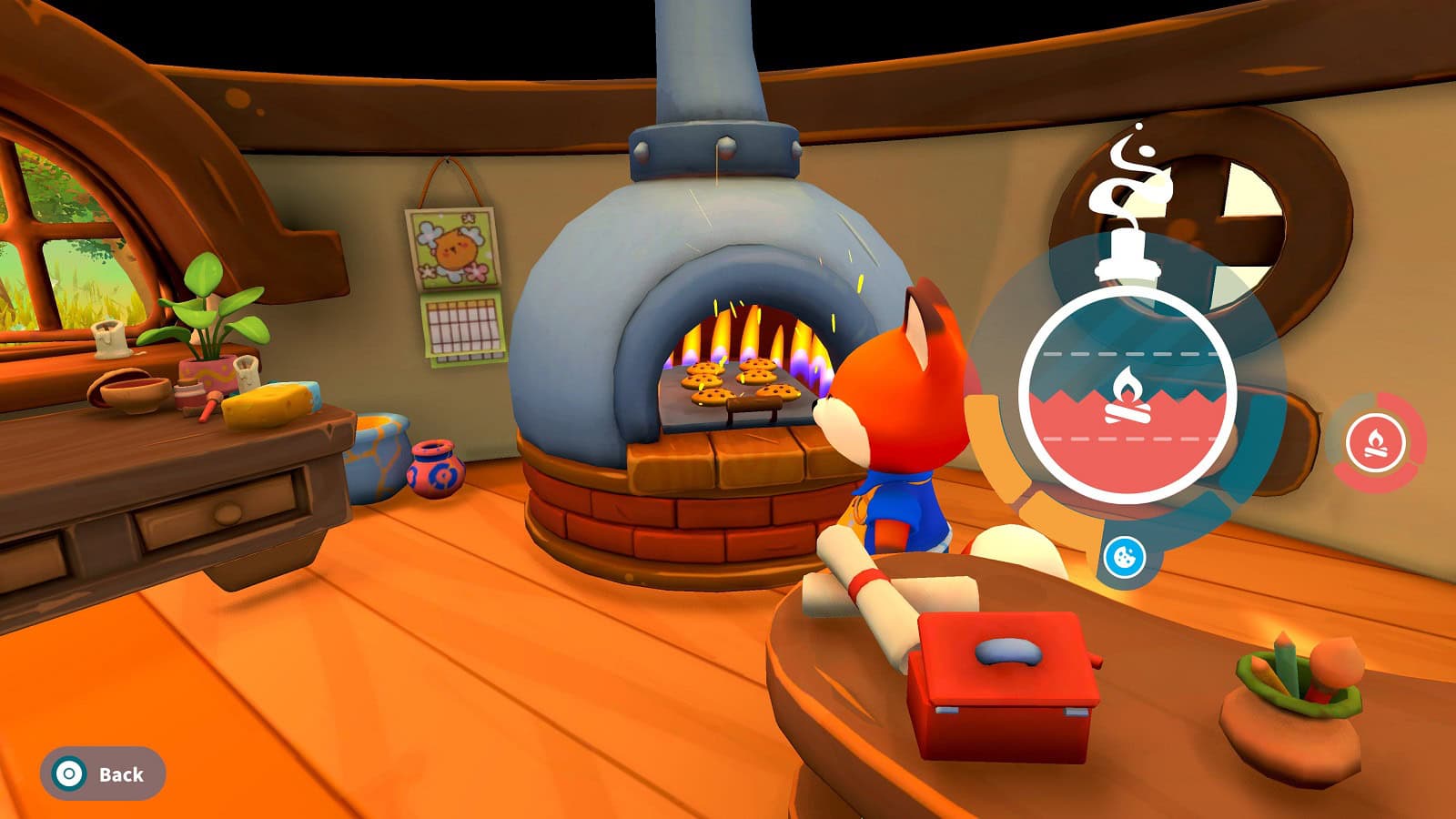
Every repair Oku makes goes towards buying new tools for the shop. They can be as practical as a cleaning tool (a sponge) or a paint station that allows you to flex your creativity a bit. The oven is a personal favorite of mine as it bathes the shop in the smell of freshly baked cookies over a cozy fire. Of course, eventually, you will run out of tools to buy with your Acorns, so what do you use them for then? Why, to build furniture and other customization options, of course! It’s not much, but you can at least add that slight personal touch and have the place looking the way you want it to, right down to the wood pattern on the walls and floor.
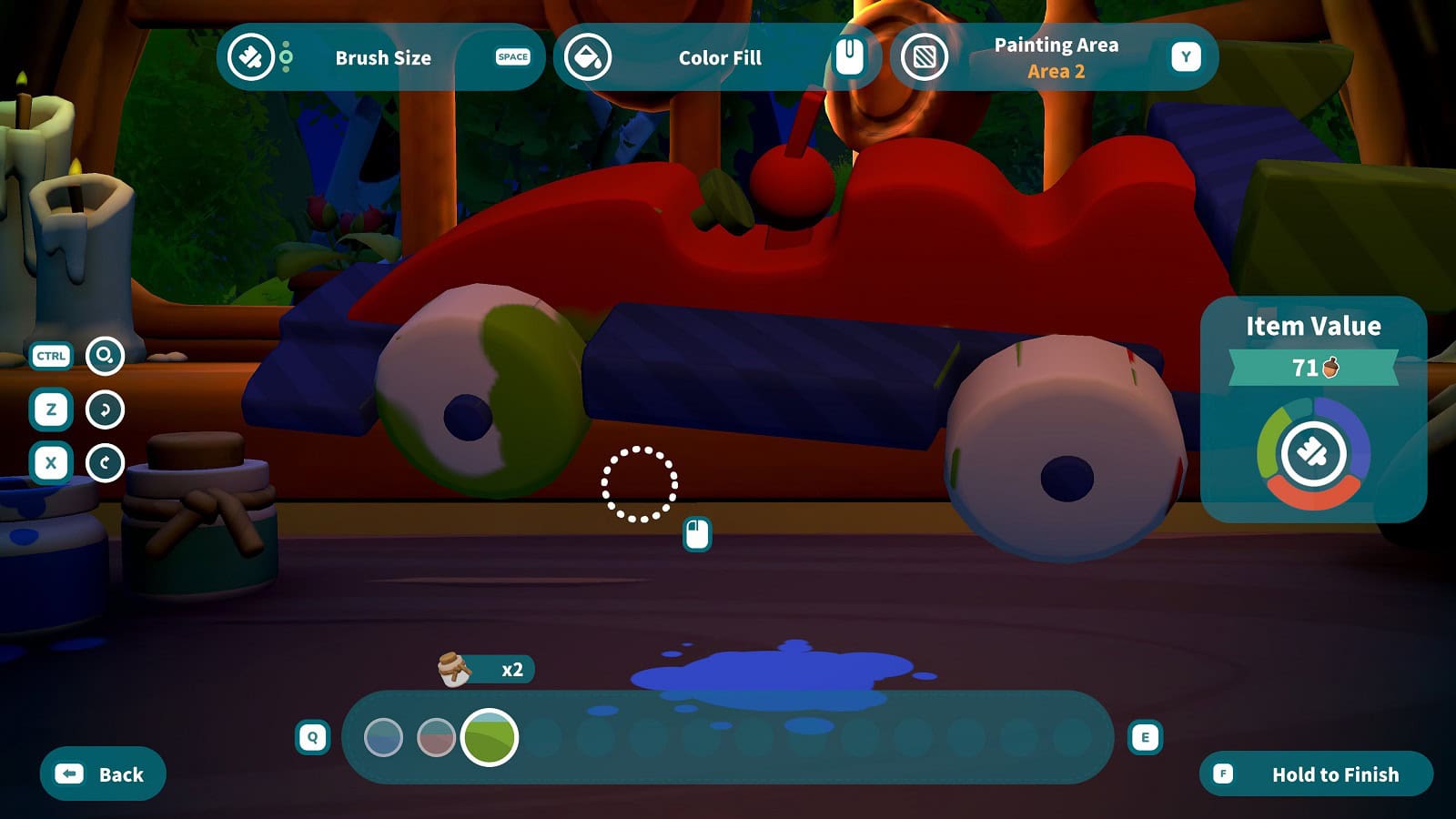
Painting allows for a modest amount of creative freedom. You can choose to hand-paint every object with as much skill and precision as your input device is capable of, or you can be somewhat lazy and use the paint bucket tool on entire sections. It’s all good. I think the painting aspect of the game has the most potential, yet also its most restricting feature. It should also be noted that you are only able to use a brush that’s functionally equivalent to the paint brush in MS Paint. It is my wish that the developers add different brushes for more delicate designs. Those race cars could do with
For starters, you can only buy red, green, and blue paint from the merchant. For other colors, you need to mix up different berries inside the berry mixer. Sounds simple, right? Wrong. You see, you can’t just start mixing colors right away. You first need to buy planters and then berry seeds to grow the different-colored berries. You can only pick three at a time, and each berry bush only produces 3 berries at a time. You see where I’m going with this? It actually takes you several in-game days to get berries to mix. It’s borderline annoying, if I’m being frank.
The issue is made worse by the fact that you go through paint so very quickly. The only way I made it work is if I kept a stockpile of berries on hand and a game plan on how I want the object to look. That’s about a week’s worth of planning right there. In fairness, if I didn’t like the game so much, I wouldn’t be making plans like this.
It would surprise you to know that there are other things to do besides running the store all day. Every once in a while, you will receive a visit from players of a game called “Bears, Bees, and Fish”. It’s basically rock, paper, scissors for forest animals. There’s not much to it, though. You receive the challenge, participate in the competition, and should you win, you move up in the league rankings. If you lose, the player pats themselves on the back and will return for a rematch the next day. By inevitably beating the number 1 player in the league, you will be treated to a short trophy award ceremony and a trophy to reminisce about on your window.
The villagers who come by to visit often have a tale or two when they want something fixed. It’s almost endearing in a way. In my head, it always goes something like, “I’m still going to repair your knick-knack. Thanks for the story, I guess?” They get so attached to the place that they sometimes leave behind objects, only revealed after a good sweeping of the floor. A guest would come by sometime later, giving a vague description of the lost item. There are some clues to past conversations, so you might want to listen to some of these tales. But otherwise, the description can be as obvious as chicken-themed glasses. It’s the little things like that gives Piece by Piece some needed depth.
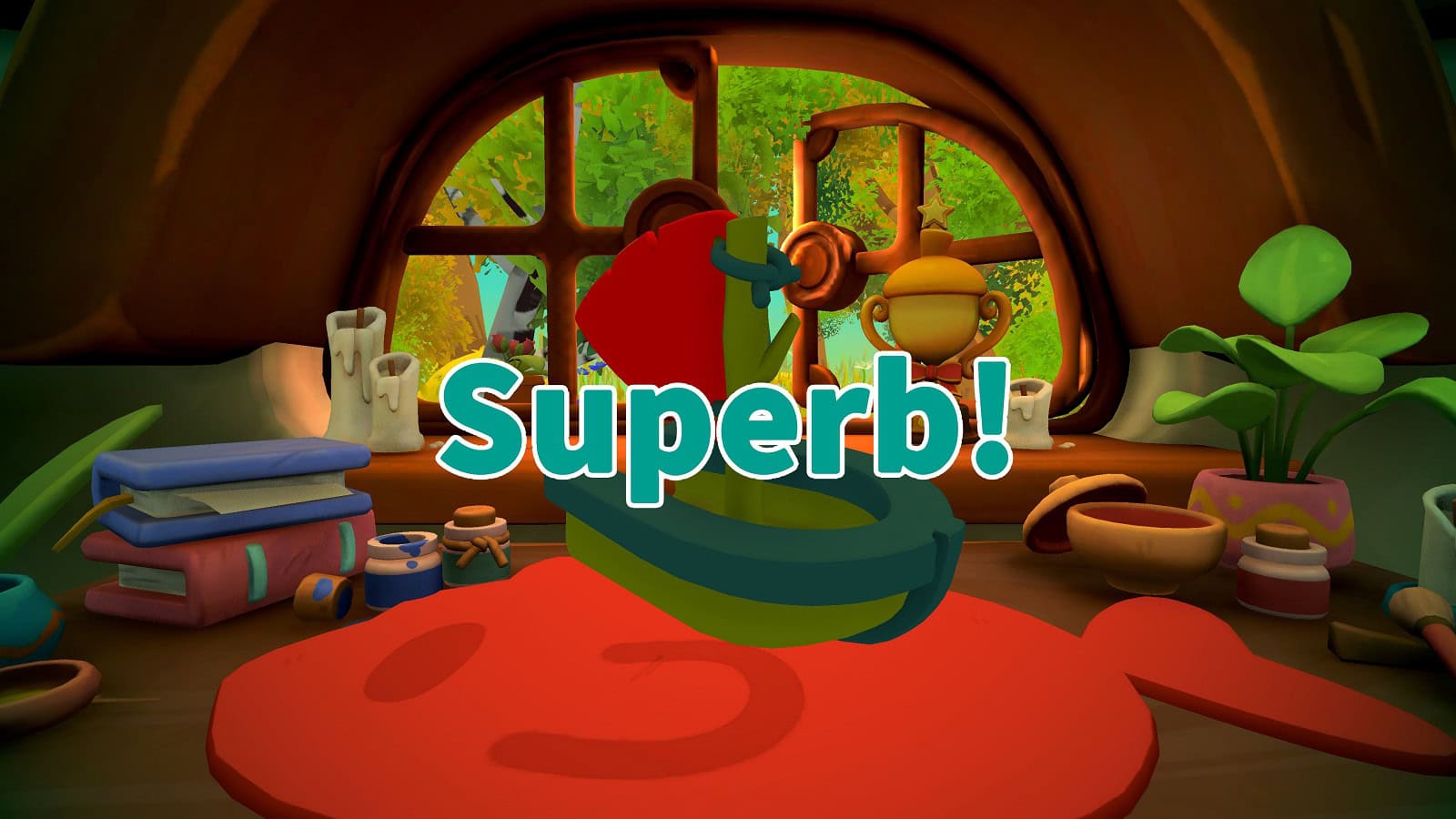
Visually, the game goes for a stylized, cutesy art style seen in the heyday of PlayStation 1 and 2. The Mayor, in particular, looks like a cuddlier version of Mr. Moneybags from the Spyro series. The writing further reinforces the family-friendly vibes from the beginning to the end. The whimsical soundtrack is both soothing and energetic. It’s so good that it almost wants me to sit still and just listen. Unfortunately, the BGM does have a tendency to cut out at random intervals. I hope that gets addressed soon.
Piece by Piece is one of those games you can load up and relax to for a couple of hours after a long and busy day. It is not demanding by any stretch and does allow you a level of creative liberty with how you want to paint objects, provided you have the patience for paints that are not primary colors. To top it all off, you can get all the game’s Steam achievements in under 10 hours just by doing what you’re doing every day in-game. If you’re looking for a chill experience with a slight inclination towards painting, then I recommend this game.
Piece by Piece Review (PC)
Piece by Piece is one of those games you can load up and relax to for a couple of hours after a long and busy day.
The Good
- Very chill gameplay
- Offers a bit of room for creative expression
- Wholesome in every way
- Whimsical soundtrack
The Bad
- Lack of an end game
- Painting minigame a little rudimentary
- Mixing paint takes too long